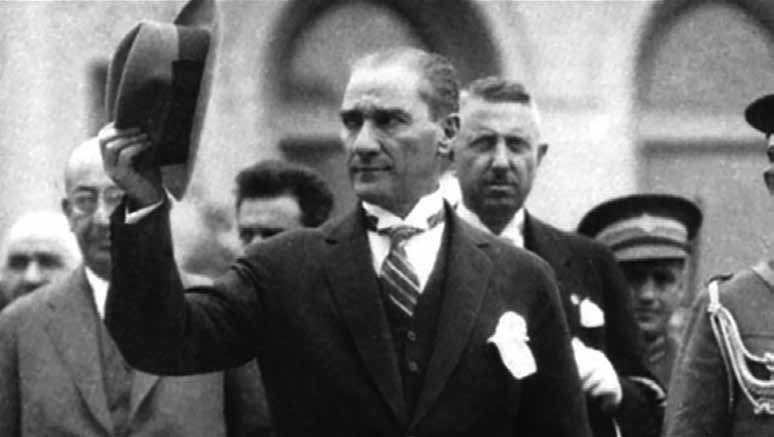
[…] After the enactment of this law, the Turkish nation, through its parliament, gave the surname Atatürk to Mustafa Kemal, meaning “the Father of Turks”. This was a way of showing appreciation and gratitude for a man who always worked for the good of his nation.
The War Against Ignorance
The year is 1921; we are in June, amidst the most feverish and critical days of the Turkish War of Independence that had then been ongoing for years following World War I. After securing victory on the eastern fronts, all military focus had been shifted to the West. Greek forces with British funding penetrated the Turkish line of defence and pushed the fire line to the fields of Kütahya-Eskişehir, located approximately 400 kilometres into the Anatolian west coast. The newly formed Turkish military was limited by financial difficulties, under-educated, and consisted of many volunteers. A nation with all its citizens was fighting for its life – the right to exist as a respected and independent society. Beginning with the Balkan Wars in 1912, the Turkish people had been experiencing war with all its cruelty in every way possible. People had lost everything to war, including their loved ones. The nation of the “Sick Man of Europe” was on its deathbed – or at least, so thought the world. The reality was different.
In reality, the young Turkish army was fighting in Bursa, Kütahya, Tavşanlı, Dumlupınar, and many more fields, but at the same time more than 200 teachers [1] from all around Türkiye were on their way to Ankara for the First Turkish National Education Congress. A meeting on education with such a wide scope and large number of participants was a first in Turkish history [2]. The goal of the Congress was clear: to shape the future of education in Türkiye. Not more than 100 kilometres away from the fronts in Kütahya, another battle was fought – the battle against ignorance. People, including the Minister of Education, Hamdullah Suphi Bey, proposed to postpone the Congress because of the war. Mustafa Kemal refused this offer immediately, saying:
“Fighting ignorance is no less important than fighting the enemy.”
The Rebirth of a Nation
After years of long wars, Türkiye won back its well-earned independence in 1922 on war fields. In 1924, this military success was certified by the Treaty of Lausanne. However, this was only the beginning of the history of the modern Turkish Republic, and Mustafa Kemal Atatürk’s plans for his nation.
Mustafa Kemal Atatürk is the founder and the first President of the modern Turkish Republic. He devoted his whole life to his country and to the good of his people. Atatürk’s ideas formed the early days of the modern Turkish Republic, and they continue to be the guide for today’s Türkiye. In the process of transforming a nation with limited financial resources and low self-esteem into one of the confident, financially and politically independent countries of the first half of the 20th century, Atatürk led countless reforms that challenged and replaced many outdated, but deep-rooted, ideas like the sultanate.
From Sultanate to Republic
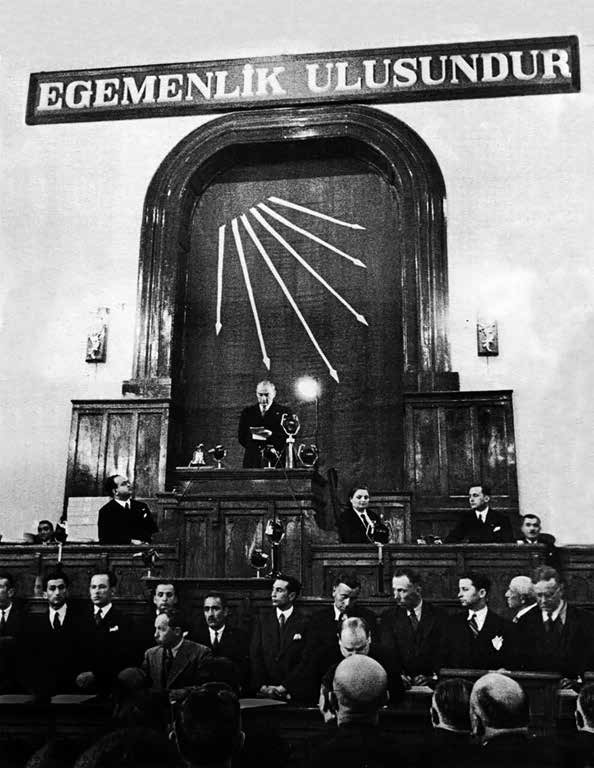
Many reforms were done in the 1930s in Türkiye, and the Republic is, without doubt, the most significant outcome of the Turkish Revolution. Turks have been under the reign of the Sultan for many centuries. However, towards the end of the Ottoman Empire’s lifetime, the governments and the regime became more and more corrupt. After the defeat in World War I, officials of the Ottoman Empire were more concerned about their titles and political positions rather than the Turkish nation and the people’s future. Therefore, Atatürk founded a parliament, the Grand National Assembly of Türkiye (TBMM), in 1920. The parliament later became the symbol and guardian of democracy. It has been more than 100 years since the abolition of the Ottoman sultanate, and, to this day, the famous tenet of the Modern Republic is inscribed on the wall of the parliament building:
“The sovereignty rests unconditionally with the nation.”
Women’s Rights and Women in Young Turkish Republic
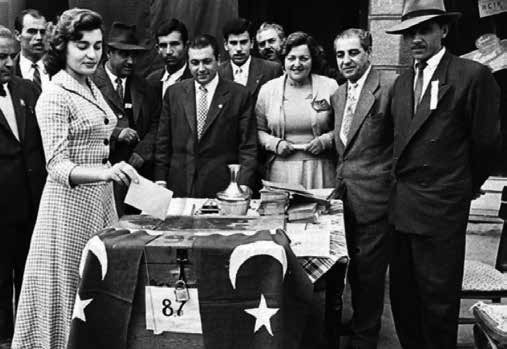
We, unfortunately, still live in a world where things get more difficult if you are a woman. The conditions were even more severe at the end of the Ottoman era. After the Turkish War of Independence, which was also fought by countless female heroes, the young Turkish Republic took a huge step towards being a country where women and men have constitutionally equal rights. The enactment of the Turkish Civil Code in 1926 was just the beginning. With the reforms led by Atatürk, women obtained the right to vote and to run for local elections in 1930, with the nationwide elections following four years later in 1934. Even though women’s suffrage is an important symbol of revolution in women’s rights, it was only one of the changes in society towards equal rights. In many fields of life, including politics, education and arts, women were advancing during the early decades of the Republic. Atatürk knew that a nation can only prosper when women and men have equal rights. He emphasised this fact by saying [3]:
“Is it possible for one half of a community to rise to the heavens while the other half remains chained to the earth?”
Revolution in Daily Life and Arts
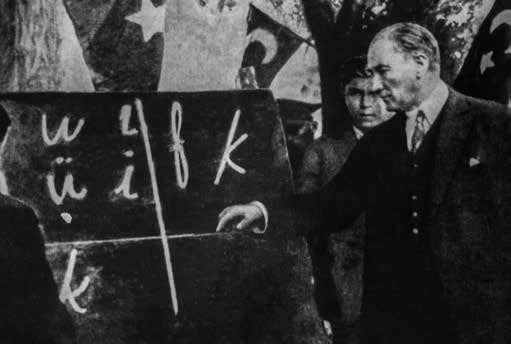
Day-to-day life of Turkish people changed significantly during the first decades of the young Republic. In 1928, the Turkish Alphabet Reform took place, in which the country adopted a new alphabet based on the Latin alphabet that includes special characters to express common sounds of the Turkish language. This reform boosted literacy rates in the long term, contributing to the modernisation of the country. Not only letters changed their appearance, but also people changed how they dressed. This was partly because of improving economic conditions and national wealth, but mostly under the influence of the fashion revolution in Türkiye aiming to modernise the overall clothing habits of the people. The most remarkable indicator of this was the Hat Law enacted in 1925. Turkish people, and in particular officials, were obliged to wear modern hats instead of the traditional fez hat. This law is still in the constitution to this day, even though it is not enforced in practice.
Atatürk’s Message
Another reform was the Surname Law, requiring all citizens to adopt a family name. The intended purpose of this change was to prevent the use of religious titles or titles implying a difference in social class. After the enactment of this law, the Turkish nation through its parliament gave the surname Atatürk to Mustafa Kemal, meaning “the Father of Turks”. This was a way of showing appreciation and gratitude for a man who always worked for the good of his nation. He led countless reforms and changed a nation’s future. Even though the Turkish Revolution ranges over a wide spectrum, Atatürk summarised the underlying aim in his speech at celebrations of the 10th anniversary of the Turkish Republic [4]:
“It is our national ideal to continuously nurture and develop our nation’s high character, tireless diligence, innate intelligence, devotion to science, love of fine arts, and sense of national unity through all means and measures. This ideal, which suits the Turkish nation, will enable it to successfully fulfil its civilised duty in ensuring true peace for all humanity.”
Not a political message, not a discriminative one. True peace for all humanity: that is the ultimate ideal of every responsible human. This is why, to this day, every generation of the Turkish nation learns many lessons from the Turkish Revolution shaped by Atatürk’s ideals and carries Atatürk’s legacy into the future.
Sources
- E. Kapluhan, “1921 Maarif Kongresi’nin Türk Eğitim Tarihindeki Yeri Ve Önemi”, YSBD, c. 4, sy. 8, 2014, doi: 10.17828/yasbed.05955.
- Sarıhan Z. (2009), 1921 Maarif Kongresi, Milli Eğitim Bakanlığı Yayınları: 4715, Bilim ve Kültür Eserleri: 1493, Ankara, p. 10.
- Atatürk Araştırma Merkezi (2024), Atatürk Araştırma Merkezi Yayınları, Atatürk’s Speeches and Statements III, ISBN 978-975-17-5783-8, p. 21.
- Turkish Ministry of Culture and Tourism: https://www.ktb.gov.tr/TR-96294/10-yil-nutku.html