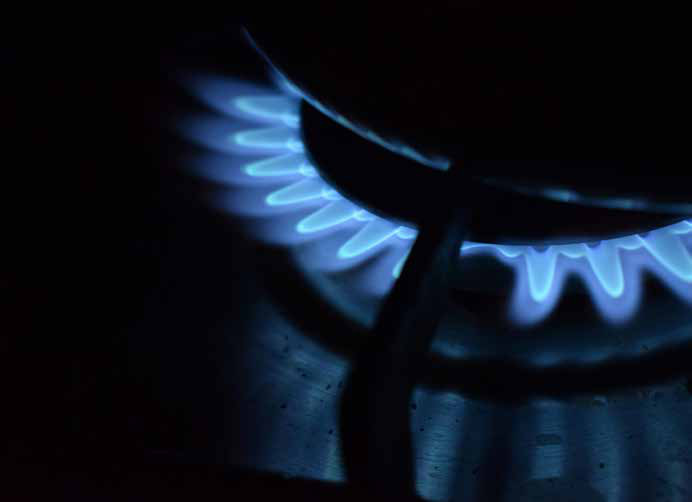
Fire appears to be pure chaos, but its wildest shapes are carved by rigid laws. The real paradox is this: the most turbulent force we know is governed by an order so strict that if it falters even for a moment, the fire dies.
1. Introduction – The Apparent Chaos of Fire
We often think of fire as the purest expression of chaos, something unpredictable and uncontrollable. Yet fire is governed by extremely precise physical and chemical laws. What we perceive as disorder is, in fact, a highly structured phenomenon. Before anything else, what is fire?
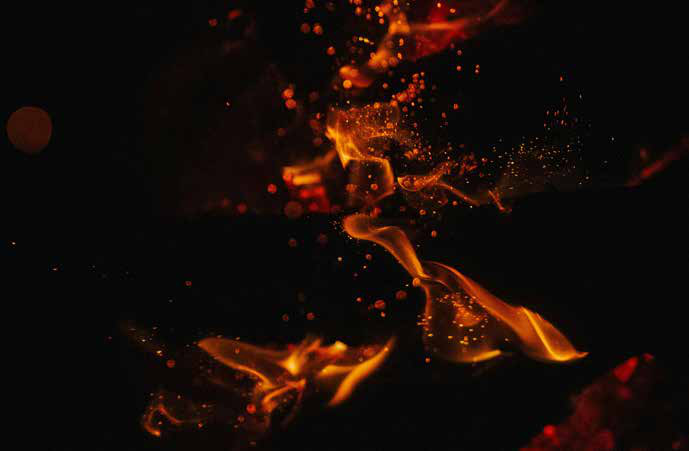
Fire, as commonly understood, can be defined as the ensemble of effects produced by a rapid, high-temperature chemical reaction between a combustible material and the oxygen in air, generating gaseous products, heat, and usually visible light. The emission of light is caused either by reaction intermediates (radicals) or by carbonaceous particles (soot) originating from incomplete oxidation and radiating in the visible range, typically with orange-yellow hues. Once initiated, the reaction sustains itself until spontaneous extinction, which occurs when the fuel is depleted, when the oxidizer is no longer available in sufficient quantity, or—particularly for solids—when the temperature of the combustible material drops below the level required to maintain vaporization or pyrolysis. For liquids and some solids, the phenomenon begins at the flash point: the minimum temperature at which the vapor concentration above the liquid reaches the lower flammability limit of the air vapor mixture. What appears as chaotic destruction is already beginning to reveal a strict internal order.
2. The order that makes combustion possible – The tetrahedron of fire
A fire can exist only if four elements are simultaneously present: fuel, oxygen, heat, and a chain reaction. These components form the fire tetrahedron, the conceptual model that describes the conditions required for a self-sustaining combustion process. Fuel must be able to release vapors or pyrolysis gases; oxygen must be available in sufficient concentration; heat must raise the material to its ignition temperature; and the chain reaction must continuously regenerate the reactive radicals that keep the process alive. If even one of these components is removed or significantly reduced, the entire system collapses and the fire extinguishes. This strict mutual dependence illustrates how combustion is not a spontaneous or disordered phenomenon, but a highly structured interaction between chemical, thermal, and physical conditions. The balance between these four elements represents the fundamental internal order that underlies every fire, regardless of its scale or apparent chaos.
3. The development of the fire – A time order
The growth of a fire does not follow random behaviour: it progresses through well-established phases—ignition, growth, full development, and decay. Each stage reflects a specific balance between fuel availability, heat release, and ventilation conditions, which together determine the speed and character of the fire’s evolution. During ignition, the material reaches its ignition temperature and begins to release combustible gases; during the growth phase, the heat release rate increases and the fire starts to influence its surroundings; in the fully developed stage, all exposed combustibles contribute to the fire; and finally, in the decay phase, the reduction of fuel or oxygen causes the heat release rate to fall. Ventilation plays a critical role in shaping these stages, controlling both the intensity and the direction of fire development. The amount and distribution of air entering a compartment determine how much energy the fire can release and how rapidly it can spread. Under specific physical conditions— sufficient temperature, strong thermal radiation feedback, and a well-defined stratification of hot gases—the system may reach a threshold known as flashover. Although flashover appears sudden and chaotic, it is the predictable outcome of a precise thermal escalation, where the accumulated energy in the compartment becomes sufficient to ignite almost all exposed surfaces simultaneously.
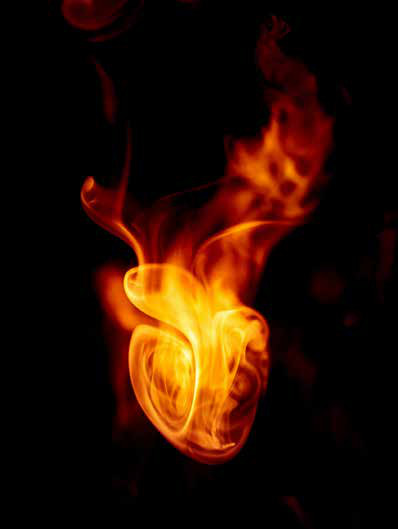
4. The flame behaviour – Order in principles, chaos in forms
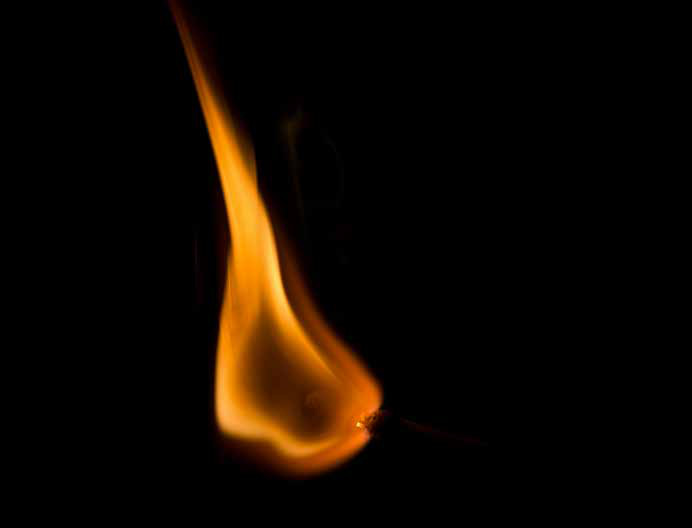
The combustion process is governed by predictable chemical and energetic laws. However, the visible flame behaves differently. The flame is a turbulent fluid-dynamic phenomenon, governed by the Navier–Stokes equations, which makes it impossible to determine its exact local motion at any given moment. We can predict what the fire will do in general terms—the overall development of the fire—but not how exactly each instantaneous fluctuation of the flame will evolve. This combination creates the core paradox: an ordered system that manifests itself through unstable and seemingly chaotic forms. At the same time, the growth of a fire does not follow random behavior. Instead, it progresses through well-established phases: ignition, growth, full development, and decay. Ventilation plays a critical role in shaping these stages by controlling the intensity and direction of fire development. Under specific physical conditions of temperature, irradiation, and smoke-layer stratification, the system may reach a threshold known as flashover. Although flashover appears sudden and chaotic, it is the predictable result of precise thermal escalation.
5. The flashover – The peak of the order that appears like chaos
Flashover marks a critical turning point in fire development. It represents the moment when the energy accumulated within a compartment reaches a level at which the thermal environment fundamentally changes. To an outside observer it may appear sudden and unpredictable, but in reality it arises from the self-reinforcing interaction of several factors: a continuous rise in temperature, intense radiant heat feedback from the hot gas layer, and the progressive stratification and heating of smoke and combustion products near the ceiling. As the upper gas layer becomes hotter and thicker, it irradiates the lower part of the compartment more aggressively, heating up all exposed surfaces. These surfaces begin to pyrolyze simultaneously, releasing additional combustible gases and further accelerating the heating process. Once the heat flux back to the fuel surfaces becomes high enough, nearly all combustibles in the compartment can ignite in a very short period of time. During the flashover phase, the thermal conditions become sufficient for almost all exposed combustibles to ignite nearly simultaneously, resulting in the entire compartment being engulfed in flames. Nothing about flashover is arbitrary; it is the culmination of a highly structured thermal process in which each contributing mechanism reinforces the next. What seems like a sudden outbreak of chaos is in fact the predictable result of ordered physical conditions reaching a critical threshold.
6. Fire Safety Engineering – The art of breaking the order of fire
Fire Safety Engineering operates by deliberately disrupting the internal order that allows combustion to sustain itself. Each suppression strategy is designed to target one element of the fire tetrahedron, breaking the equilibrium that keeps the reaction active. Cooling reduces the temperature of the fuel surface below its ignition point, stopping pyrolysis and slowing the release of flammable gases. Smothering limits or removes oxygen, pushing the system below the lower level of oxidizer necessary for combustion. Fuel removal eliminates the material capable of degrading into vapors or pyrolysis products, interrupting the supply chain of combustible gases. Chemical inhibition interferes with the chain reaction by neutralizing reactive radicals, preventing the self-sustaining nature of the flame. Extinguishment is therefore the engineering of disorder: an intentional interruption of the structured interactions that make combustion possible. Prevention follows the same logic. By understanding the internal order of fire, Fire Safety Engineering can shape the conditions that determine whether an ignition develops into a self-sustaining fire. Control of ventilation paths, the distribution and reaction to heat, material properties, and compartmentation layout allows the designer to prevent the establishment of the continuous feedback mechanisms -thermal, chemical, and fluid-dynamic- that a fire requires to grow. A building is made safer not by resisting fire arbitrarily, but by disrupting the very processes that fire depends on.
7. Conclusion – An order that takes the form of chaos
A fire is a physical and chemical phenomenon governed by strict rules: reaction kinetics, heat transfer, gas stratification, and ventilation dynamics all follow established principles. The evolution of an enclosure fire -its ignition, growth, fully developed stage, and decay- can be described through predictable mechanisms. Yet the flame itself introduces an appearance of disorder due to the turbulent and fluid-dynamic behaviour of hot gases. The movement of the flame front, driven by buoyancy and turbulent mixing, cannot be precisely predicted at a local scale, giving fire its characteristic impression of chaos. Understanding this paradox -the ordered foundation behind the chaotic surface- allows Fire Safety Engineering to operate with more precision. By recognizing which aspects of fire behaviour are predictable and which manifestations are inherently unstable, engineers can design buildings that interrupt critical thresholds, delay thermal buildup, and control the flow of hot gases. Safety emerges not from resisting chaos, but from understanding the hidden order that produces it. Through this awareness, we can create environments that are more resilient, more controllable, and ultimately safer for the people who occupy them.